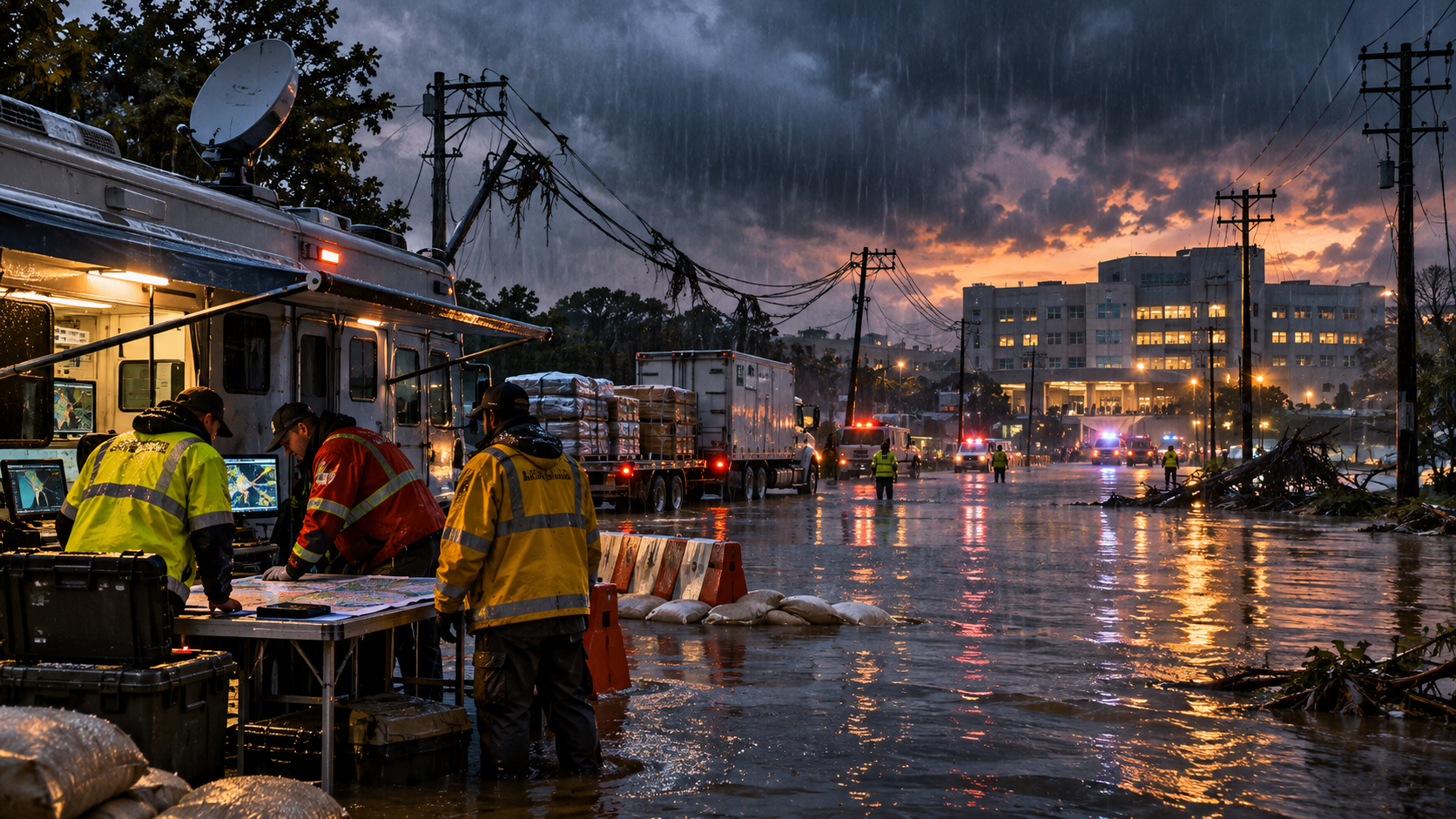
There's something I've always found troubling about the way we discuss disaster preparedness.
We spend enormous amounts of time developing emergency operations plans, establishing chains of command, negotiating mutual-aid agreements, and conducting exercises designed to demonstrate that we're ready for the worst.
Then the worst happens.
And suddenly, the people responsible for executing those plans discover that the roads are impassable, the communications systems aren't functioning, the resources they were counting on aren't available, and the organizations they need assistance from are dealing with emergencies of their own.
None of this should come as a surprise.
Yet somehow, it frequently does.
The problem isn't necessarily that organizations failed to plan for a disaster. It's that they planned for a disaster in which too many other things continued working.
A Disaster Is Never Just One Emergency
Consider the heavy rains that struck Gaza beginning November 6.
According to the United Nations Office for the Coordination of Humanitarian Affairs, by November 8 humanitarian organizations had received requests for assistance from more than 26,000 households affected by the flooding.
Shelters were damaged or destroyed. Essential services were disrupted. Humanitarian organizations were attempting to respond while their available stocks of tents, tarpaulins, blankets, and other necessities were nearly exhausted.
Meanwhile, more than 150,000 tents purchased by humanitarian partners and governments remained outside Gaza awaiting delivery, with funding, approvals, and transportation among the obstacles to getting assistance where it was needed.
Think about what that means.
Resources existed.
People needed those resources.
But the ability to connect the two was severely constrained.
And that's an important distinction in disaster management.
Having resources is not the same thing as having the operational ability to deliver them.
A warehouse full of emergency supplies does very little good if transportation is unavailable, access is restricted, or nobody can establish a functioning distribution operation.
The Gaza situation involves extraordinary conflict-related constraints, so it would be irresponsible to treat it as an ordinary emergency-management failure. Nevertheless, it illustrates a critical principle that applies far beyond any single disaster.
Logistics is not a supporting function that becomes important after the emergency begins.
Logistics is part of the emergency response itself.
The Problem With Depending on Someone Else
Now consider a different kind of vulnerability.
In August 2026, the U.S. Government Accountability Office released a report examining workforce readiness at the Federal Emergency Management Agency.
The findings deserve serious attention.
During fiscal year 2025, more than 4,300 employees separated from FEMA, representing a 55 percent increase in separations compared with the previous fiscal year.
The GAO also found that FEMA had undertaken workforce reductions without adequately assessing how those decisions would affect its ability to meet future mission requirements.
That's a significant concern for an agency expected to help coordinate responses to major disasters, including multiple emergencies occurring simultaneously.
But I want to make an important distinction.
This isn't an argument that FEMA should be expected to do everything.
It shouldn't.
Federal disaster assistance is an essential component of our national emergency-management system, but it cannot be the only component upon which an organization depends.
Hospitals, utilities, telecommunications providers, local governments, and critical infrastructure operators all have responsibilities that begin long before federal assistance arrives.
If your disaster recovery strategy assumes that someone else will arrive within a particular timeframe, you had better understand what happens when they don't.
What happens if the neighboring county is dealing with the same disaster?
What happens if the contractor responsible for restoring your equipment has twenty other customers ahead of you?
What happens if your mutual-aid partner has already committed its available personnel elsewhere?
And what happens if the emergency lasts seven days instead of seventy-two hours?
A dependency that hasn't been tested under conditions of simultaneous demand is an assumption, not a guarantee.
The First Failure Is Rarely the Last
One of the most dangerous misconceptions in disaster planning is the idea that an emergency can be managed as a collection of isolated problems.
A hospital loses commercial power.
Its generators start.
Problem solved, right?
Not necessarily.
What happens when the generator's fuel supply begins running low?
What happens when the roads needed for fuel delivery are flooded?
What happens when the telecommunications systems coordinating that delivery are unavailable?
What happens when the staff responsible for maintaining the generators cannot reach the facility?
And what happens when the hospital itself is receiving casualties from the same disaster?
The original power failure may no longer be the most serious problem.
The interaction between failures becomes the problem.
This is why I believe disaster preparedness must account for cascading failures, competing priorities, and the possibility that multiple organizations will need the same limited resources at exactly the same time.
It isn't enough to demonstrate that a backup system works.
You need to understand what that backup system depends on, what happens when those dependencies fail, and how long essential operations can continue under those conditions.
Leadership Matters, but So Does the System Behind It
It's easy to criticize leadership after a disaster.
Sometimes that criticism is justified.
But I think we need to be careful about confusing a person being overwhelmed by an extraordinary emergency with an organization that was never adequately prepared to support that person.
An incident commander cannot coordinate resources that nobody has identified.
A hospital administrator cannot maintain services indefinitely without personnel, supplies, or functioning infrastructure.
An emergency manager cannot execute a mutual-aid agreement if the participating organizations lack the ability to fulfill their commitments.
That's why effective disaster management requires more than competent individuals.
It requires clearly defined authority, reliable communications, realistic resource planning, trained personnel, and the ability to make decisions when the normal organizational structure is no longer functioning as expected.
And those capabilities need to be tested together.
Not individually.
Not exclusively under ideal conditions.
Together, under circumstances where multiple systems are failing and the available options are getting worse.
What This Means for Atlas
At Atlas Global Technologies, these are among the problems we're designing our proposed Atlas Resilience Services platform to address.
Our approach is intended to connect emergency response, medical continuity, telecommunications, logistics, infrastructure resilience, and operational coordination into a more integrated framework.
The objective is not simply to establish another emergency operations center or create another layer of reporting.
It's to develop an operational environment in which decision-makers can understand what resources are actually available, where those resources are located, whether they can be deployed, and what dependencies could prevent their successful use.
We're also developing a Continuity Stress Framework intended to evaluate how essential services behave when multiple failures occur simultaneously.
That includes examining the difference between resources that appear available on paper and resources that can actually be delivered under adverse conditions.
These are proposed capabilities and design objectives. Atlas is in its prelaunch stage, and these systems have not yet been demonstrated as an operational, independently validated disaster-response network.
The engineering challenge ahead is to turn those objectives into measurable, testable performance.
Because a concept, no matter how promising, is not a substitute for demonstrated capability.
The Obligation Doesn't End With Having a Plan
I believe organizations responsible for essential services have an obligation to prepare for more than the initial emergency.
They have to prepare for what happens afterward.
When the generators need fuel.
When the responders need relief.
When the hospitals run out of capacity.
When the roads remain closed.
When the communications networks are still unavailable.
And when the people depending on those organizations have nowhere else to turn.
That doesn't mean every organization can prepare for every conceivable disaster.
It means we have a responsibility to identify our vulnerabilities, acknowledge our limitations, and avoid presenting assumptions as capabilities.
Because ultimately, disaster preparedness isn't measured by the thickness of an emergency operations plan.
It's measured by what the organization can actually accomplish when the assumptions supporting that plan begin to fail.
The disaster doesn't care about your organizational chart.
And the people depending on you shouldn't have to discover its weaknesses when their lives are already at risk.
Sources and further reading
United Nations Office for the Coordination of Humanitarian Affairs, Humanitarian Situation Report: Heavy Rains in the Gaza Strip, November 8, 2026 (published November 9).
https://www.ochaopt.org/content/humanitarian-situation-report-heavy-rains-gaza-strip-8-november-2026U.S. Government Accountability Office, FEMA Workforce: Staff Reductions and Lack of Planning May Impact Mission Readiness, GAO-26-108427, August 4, 2026.
https://www.gao.gov/products/gao-26-108427
Join the discussion: What's the most dangerous untested assumption you've encountered in an emergency operations or disaster recovery plan? And how should organizations demonstrate that their plans can survive the failure of the resources they depend on?