Most businesses understand why they need cybersecurity. They install firewalls, deploy antivirus software, require employees to use VPNs, and increasingly rely on managed security services to protect their networks.
But there's a question I think more organizations need to ask.
What happens when the technology responsible for protecting your network becomes the attacker's way in?
It's an uncomfortable question because it challenges something we've become accustomed to in IT: trusting our security infrastructure.
And that's precisely why we need to talk about it.
The Security Guard Has the Keys
Think about how remote access works.
An organization needs employees, contractors, and administrators to connect to internal systems from outside its facilities. To accomplish this, it deploys a VPN or another remote-access gateway.
That gateway authenticates connections and provides access to authorized resources.
Under normal circumstances, that's exactly what we want.
But a remote-access gateway is still a computer system. It runs software, requires updates, has administrative privileges, and can contain vulnerabilities.
If attackers compromise that gateway, they may gain access to information or systems that the gateway was originally installed to protect.
Depending on the vulnerability and the surrounding architecture, they might steal credentials, intercept information, or attempt to move into other parts of the network.
Recent security reporting concerning Ivanti Connect Secure vulnerabilities illustrates why this issue deserves attention. A device deployed to protect remote access can itself become a privileged foothold for an attacker.
But this isn't exclusively an Ivanti problem.
The same fundamental concern applies to firewalls, VPN concentrators, security management platforms, and other infrastructure entrusted with protecting an organization's systems.
The important distinction is that compromising a gateway does not automatically give an attacker control over everything behind it.
Whether the compromise spreads depends on how the rest of the infrastructure is designed.
Getting Inside Shouldn't Mean Getting Everywhere
For years, many organizations approached cybersecurity primarily through perimeter defense.
Protect the boundary. Authenticate users. Inspect incoming traffic. Keep unauthorized connections outside.
Those protections remain important.
The problem begins when an organization assumes that anything operating inside its network can automatically be trusted.
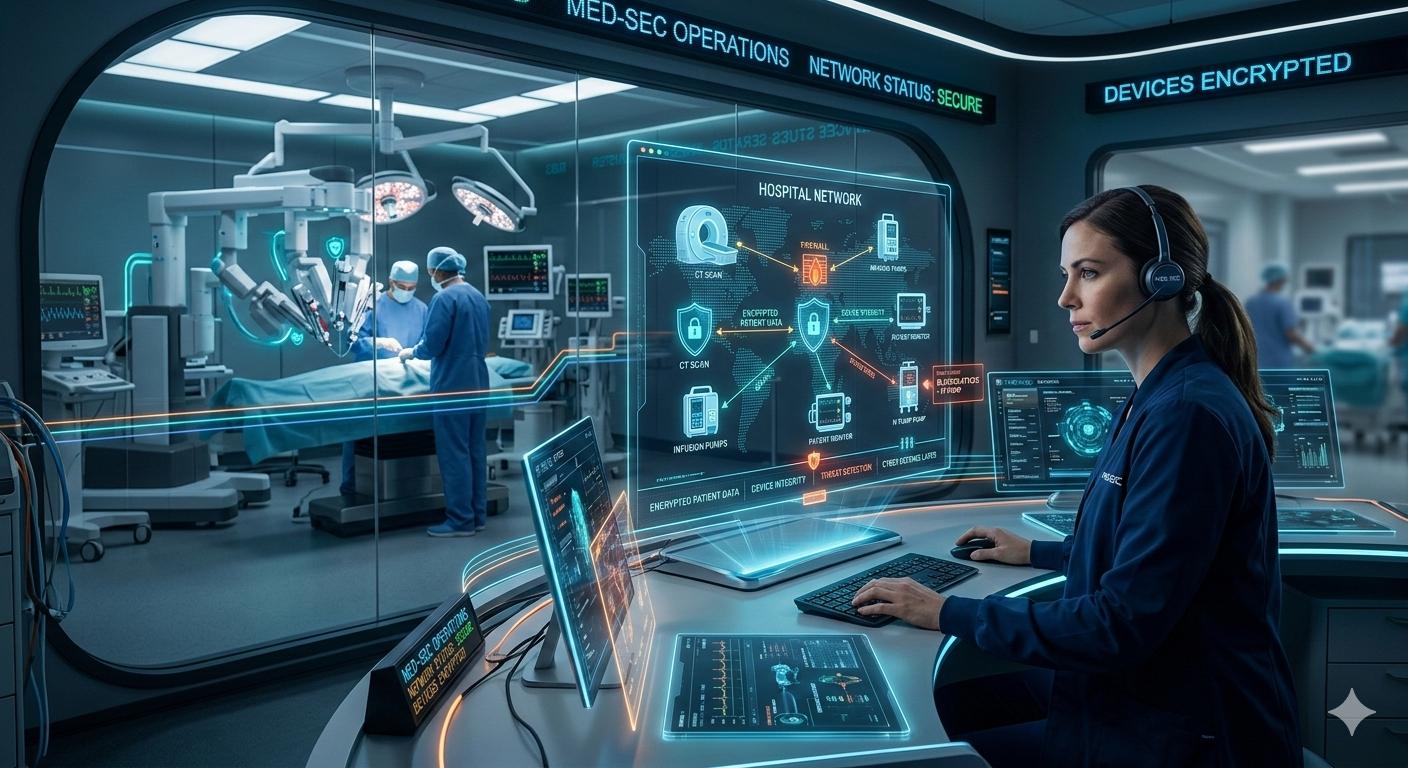
Consider a hypothetical hospital.
A remote-access gateway allows an outside technology vendor to maintain a particular clinical application.
An attacker compromises that gateway.
Now consider two possible environments.
In the first, the gateway has broad network connectivity. Administrative credentials are shared across systems, and management interfaces are accessible from the same network.
The attacker may be able to move from the gateway into additional systems, potentially reaching infrastructure that was never intended to be accessible through that connection.
In the second environment, the gateway has tightly restricted permissions. Access to clinical systems requires separate authorization. Administrative credentials are isolated, and network segmentation limits which resources can communicate.
The gateway compromise is still serious.
But the attacker has fewer opportunities to expand it.
There's another important consideration.
The systems responsible for enforcing those security boundaries must not depend entirely on the equipment that has been compromised.
If a compromised gateway can change the rules governing its own access, interfere with the systems monitoring it, or reach the administrative infrastructure responsible for containing it, then the organization may have a much larger problem.
That's the difference between relying on a security product and designing a security architecture.
What Zero Trust Actually Means
You've probably heard the term Zero Trust.
Unfortunately, it's become one of those cybersecurity expressions that gets attached to nearly everything.
The underlying concept is straightforward.
A device, user, or application shouldn't receive unrestricted access simply because it's connected to a particular network.
Access should be explicitly authorized according to identity, context, and the resource being requested.
The National Institute of Standards and Technology explains these principles in Special Publication 800-207, Zero Trust Architecture.
But Zero Trust isn't a product you purchase and install over a weekend.
It requires organizations to understand their systems, establish appropriate access policies, and enforce those policies consistently.
It also requires understanding whether the information used to make access decisions can be trusted.
If a device reports that it's healthy, how does the organization know that report is accurate?
If an administrator's credentials are valid, does that automatically mean every requested action should be permitted?
And if a security controller becomes compromised, can it grant itself additional authority?
These questions become particularly important as organizations introduce more automation into their infrastructure.
Zero Trust doesn't eliminate vulnerabilities.
It helps limit what an attacker can accomplish when something goes wrong, provided the controls enforcing those boundaries remain effective.
Security and Continuity Are Not the Same Thing
Here's where I believe the conversation needs to go further.
Organizations invest considerable resources in preventing cyberattacks.
That's necessary.
But prevention alone doesn't answer what happens when a security control fails.
Can administrators isolate the affected system without losing control of the entire network?
Can critical applications continue operating?
Can security teams investigate the incident without depending on logs stored exclusively on the compromised equipment?
Can the organization recover without restoring the same vulnerability that caused the problem?
For a retail business, the consequences might include interrupted transactions or unavailable inventory systems.
For a hospital, the stakes can be considerably higher.
A network disruption could affect access to clinical records, diagnostic systems, communications, or other services required for patient care.
That doesn't mean every cybersecurity incident becomes a clinical emergency.
It means the organization needs to understand which dependencies could turn one into another.
Cybersecurity attempts to prevent unauthorized activity. Operational continuity addresses how the organization functions when prevention fails.
Both are necessary.
When Automation Becomes Part of the Problem
There's another dimension to this conversation that's becoming increasingly important as organizations introduce artificial intelligence into their security operations.
What happens when the automated system responsible for detecting and responding to threats makes the wrong decision?
Or worse, what happens when an attacker compromises the information that system relies upon?
Imagine an automated security platform that detects suspicious activity and decides to isolate part of a network.
That sounds reasonable.
But what if the activity was misidentified? What if the information was outdated? What if the system issuing the instruction had itself been compromised?
In a hospital, an incorrect isolation decision could interrupt services that were never involved in the original incident.
That's why I believe we need to distinguish between automated decision-making and the authority to enforce those decisions.
An intelligent system can analyze activity, identify potential threats, and recommend a response.
But that doesn't mean it should have unrestricted authority to change network connectivity, administrative permissions, or critical infrastructure operations.
Those actions should be governed by independently enforced policies that establish what the system is permitted to do, under what circumstances, and with what safeguards.
And when the information necessary to make a safe decision is unavailable or unreliable, the infrastructure needs a predefined way to respond.
That might mean restricting access, isolating an affected component, or maintaining essential services in a reduced operating mode.
The appropriate response depends on the system and the consequences of the action.
The objective isn't simply to make security automation faster. It's to make sure that automation cannot turn one security incident into a much larger operational failure.
Designing for Failure
At Atlas Global Technologies, one of the principles we're incorporating into our proposed infrastructure architecture is that the compromise of one system should not automatically compromise another.
That involves independent security boundaries, restricted administrative access, segmented networks, protected logging, and carefully defined recovery procedures.
We're also examining how automated infrastructure management can operate within predefined limits rather than relying exclusively on an intelligent system's judgment.
Our proposed Talos 2.0 and Cognition Engine architecture is intended to distinguish between intelligent analysis and independently governed enforcement.
The objective is to allow automation to identify problems and coordinate appropriate responses without giving it unrestricted authority over the infrastructure it manages.
We're developing continuity stress scenarios intended to examine how infrastructure behaves when individual components are unavailable, compromised, or providing unreliable information.
These are design objectives and planned validation activities, not claims that Atlas has already demonstrated these capabilities in a production deployment.
And they raise questions every organization should consider, regardless of its size.
What systems are allowed to trust one another?
Who can change those relationships?
What happens when an administrator's credentials are stolen?
Can a compromised security appliance interfere with the systems responsible for detecting or containing the compromise?
Can automated security controls make changes that disrupt unrelated systems?
And when something goes wrong, can the organization demonstrate that its containment procedures actually work?
Because there's a significant difference between drawing security boundaries on an architecture diagram and demonstrating that those boundaries hold during an incident.
The Question Worth Asking
I'm not suggesting that organizations abandon firewalls, VPNs, or other security technologies.
Quite the opposite.
They remain essential components of a properly designed security program.
But no individual product should become the foundation of an organization's entire security strategy.
Products can fail. Credentials can be stolen. Software can contain vulnerabilities. Administrators can make mistakes. Automated systems can make incorrect decisions.
A mature cybersecurity strategy acknowledges those possibilities and establishes additional protections around them.
The objective isn't to pretend that compromise is impossible.
It's to prevent one compromise from becoming an organization-wide failure.
And that starts with asking a question that deserves considerably more attention:
If the system protecting your infrastructure becomes compromised tomorrow, how much of your organization can it take down with it?
And perhaps just as importantly:
Have you actually tested what happens next?
That's a conversation worth having.
Further Reading
NIST: SP 800-207, Zero Trust Architecture (2020)
https://csrc.nist.gov/pubs/sp/800/207/finalNIST: SP 800-207A, A Zero Trust Architecture Model for Access Control in Cloud-Native Applications in Multi-Cloud Environments (2023)
https://csrc.nist.gov/pubs/sp/800/207/A/finalRapid7: Additional Ivanti Connect Secure Zero-Days Exploited in the Wild (technical analysis referenced in this week's intelligence brief)
https://www.rapid7.com/blog/post/etr-additional-ivanti-connect-secure-zero-days-exploited-in-the-wild-cve-2026-111357-cve-2026-118527/MITRE: Framework for Continuous Remote Attestation
https://www.mitre.org/news-insights/publication/framework-continuous-remote-attestation
About Atlas Global Technologies
Atlas Global Technologies is a prelaunch technology company developing an infrastructure and services model focused on networking, cybersecurity, operational continuity, and resilient systems engineering.
Outside the Rack. Inside the WAN. explores the engineering decisions, operational assumptions, and industry developments shaping modern infrastructure.