There's a question I expect to hear quite often as Atlas Global Technologies moves forward:
Why don't you start smaller?
It's a fair question. When you're proposing a global infrastructure platform involving telecommunications, cybersecurity, energy, healthcare, aviation, and continuity operations, the capital requirements are going to attract attention.
And they should.
But there's a fundamental misunderstanding behind the suggestion that we could simply build a smaller version of Atlas and expand it later.
The first four Atlas brain sites aren't just the beginning of our expansion plan. They're the foundation of our proof of concept.
Four brains, one integrated proof of concept
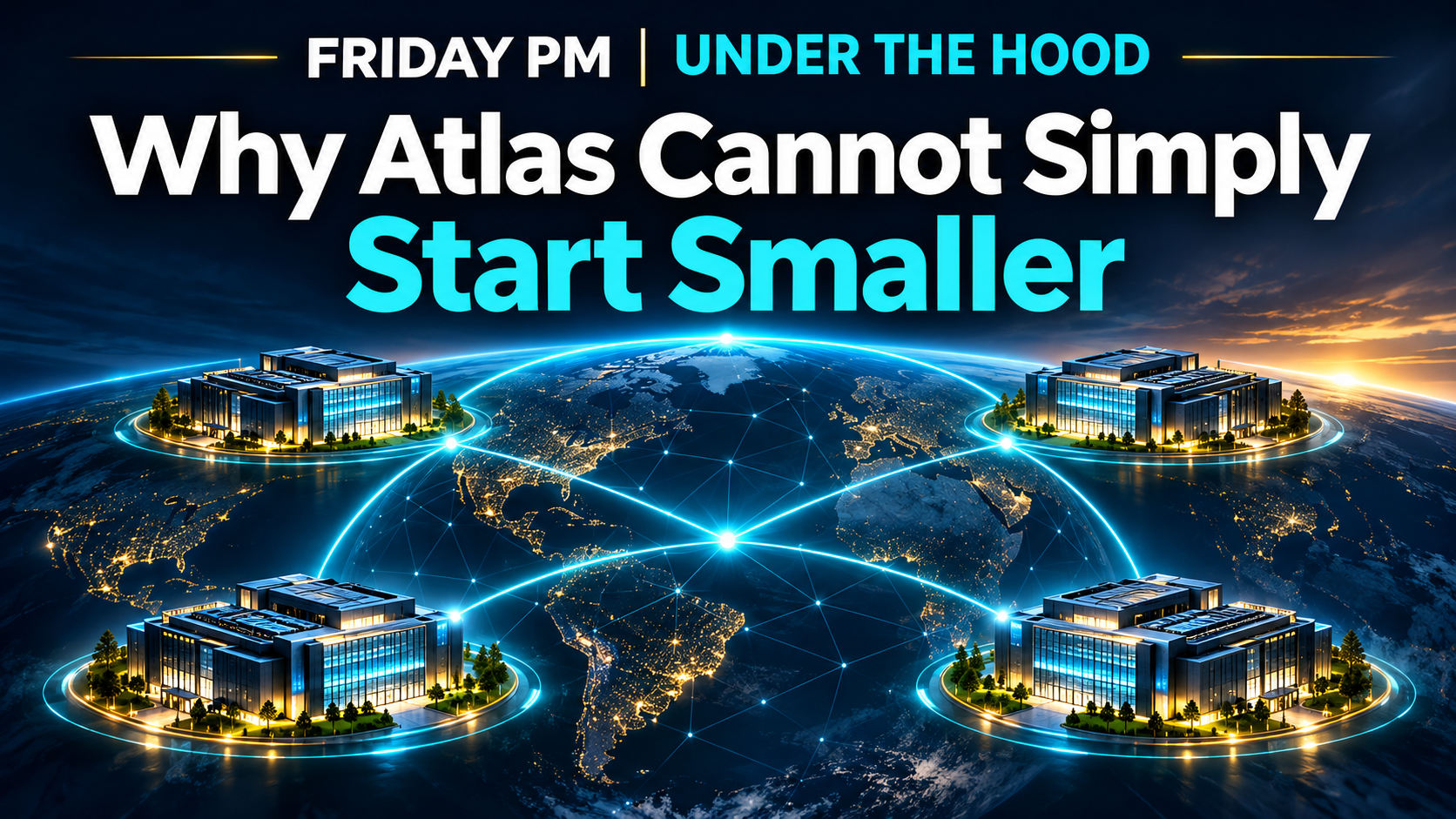
Atlas is being designed around four geographically distributed primary operational centers, which we refer to as our brains.
Each is intended to serve as a proof-of-concept environment for the operating companies, infrastructure systems, and revenue-generating activities that make up the broader Atlas model.
That includes far more than networking equipment and data center space.
We're talking about demonstrating how independent but interconnected businesses can operate together, how essential services can continue during infrastructure failures, and how the underlying assets can support multiple operational requirements.
The four sites also give us the geographical distribution needed to test one of our most important architectural principles:
No Shared Fate.
A system designed to survive the loss of a facility cannot be adequately evaluated by demonstrating that everything works inside a single facility.
We need to understand what happens when sites become isolated, when connectivity degrades, when operational responsibilities shift, and when services must continue without their original supporting infrastructure.
That requires more than one location. Our proposed four-brain architecture establishes the initial environment in which those capabilities can be evaluated.
Continuity isn't just redundancy
One of the biggest mistakes I see in infrastructure planning is treating redundancy and continuity as interchangeable concepts.
They aren't.
You can have redundant servers, redundant power supplies, redundant network connections, and redundant facilities, and still have a common failure that disrupts the entire operation.
Atlas is intended to address the relationships between those systems, not merely duplicate their components.
Our proposed WAN architecture uses distributed Core, Aggregation, and POP sites to support customer services. When one component becomes unavailable, the design calls for another eligible site to assume that component's responsibilities while the unaffected parts of the service remain operational.
The objective is to preserve essential customer functions, potentially at reduced capacity, rather than allowing one failure to become a widespread interruption.
That is the design objective. Whether the proposed mechanisms achieve the required performance, capacity, and recovery behavior is precisely what our engineering validation must establish.
Why the operating companies matter
There's another reason Atlas cannot be evaluated as a conventional data center development.
Our infrastructure is intended to support several distinct businesses.
Energy generation has its own economics, operational responsibilities, and asset requirements. Telecommunications has another. Healthcare, security, aviation, and the other operations bring their own requirements.
The purpose of the initial architecture is to demonstrate how those businesses function both independently and together.
That doesn't mean every business gets a free pass simply because it's part of Atlas.
Quite the opposite.
Our financial model is built around individually accountable operating companies and special-purpose entities, each responsible for its own obligations.
We've established three gates to profitability.
The first is operational sustainability: revenue covers operating expenses.
The second is financial sustainability: revenue covers all obligations that must be satisfied before free cash flow.
The third is Atlas-qualified profitability: a coverage ratio of 1.25 to 1.35 times those pre-free-cash-flow obligations.
An entity's progress through those gates must be evaluated against its actual stage of development, construction progress, market conditions, and business performance.
A business that's still being built cannot reasonably be judged on the same timetable as one that's been operating at commercial scale for years.
But neither can management use the phrase still maturing as an excuse to avoid accountability.
Financial continuity matters, too
We've also been examining how Atlas can provide financial flexibility without undermining the separation between its businesses.
Under our proposed structure, each operating company and asset entity would first meet its applicable financial obligations. It would then distribute 70% of its free cash flow to the holding company.
Of those receipts, 85% would be allocated to a dedicated liquidity pool.
We're considering placing that pool in a separate Treasury SPE, managed by HoldCo for an annual fee of 2% of the pool's defined balance.
The Treasury SPE would provide properly documented, arm's-length bridge financing to eligible Atlas entities. It could also invest available reserves in conservative, liquid instruments to generate additional income.
After its applicable obligations and management costs, earnings would remain in the pool to support future needs.
Critically, the pool would maintain a protected minimum liquidity reserve. A single struggling subsidiary shouldn't be able to exhaust the financial resources intended to support the broader organization.
The precise legal, tax, lending, and investment arrangements still require further development and professional review.
But the underlying objective is straightforward.
Financial distress should be contained just as deliberately as an infrastructure failure.
Can Atlas reduce the initial capital requirement?
Absolutely, that's a question worth examining.
There's a difference between reducing the capacity of an initial deployment and removing the architectural elements necessary to demonstrate the model.
We should investigate staged construction, phased equipment deployment, commercial demand, and financing efficiency.
We should also be willing to challenge our assumptions about what must be built immediately and what can be expanded later.
But removing an essential part of the proof of concept simply to make the initial budget look better would defeat the purpose of the exercise.
If we want to demonstrate a geographically distributed continuity platform supporting multiple independent businesses, we have to build and test an environment capable of demonstrating those relationships.
Otherwise, we've proven something else.
The real question
The question isn't simply whether Atlas could be made smaller.
Of course we could build a smaller facility, install less equipment, and offer fewer services.
But would that smaller project demonstrate the integrated operating model we're proposing?
Would it test the geographic separation, operational independence, financial accountability, and continuity mechanisms that define Atlas?
That's the question that matters.
The four-brain model is our proposed starting architecture. The proof of concept exists to challenge that design, measure its performance, identify its weaknesses, and establish which assumptions deserve further investment.
We're not claiming that the design has already passed those tests.
We're saying those are the tests we intend to conduct.
Because building something smaller is easy. Proving that you've built the right thing is considerably harder.
Atlas Global Technologies is in its prelaunch planning and development stage. The architectures, financial structures, and capabilities discussed here are proposed designs and objectives, not representations of deployed or independently validated systems.
Outside the Rack. Inside the WAN.
Atlas Global Technologies