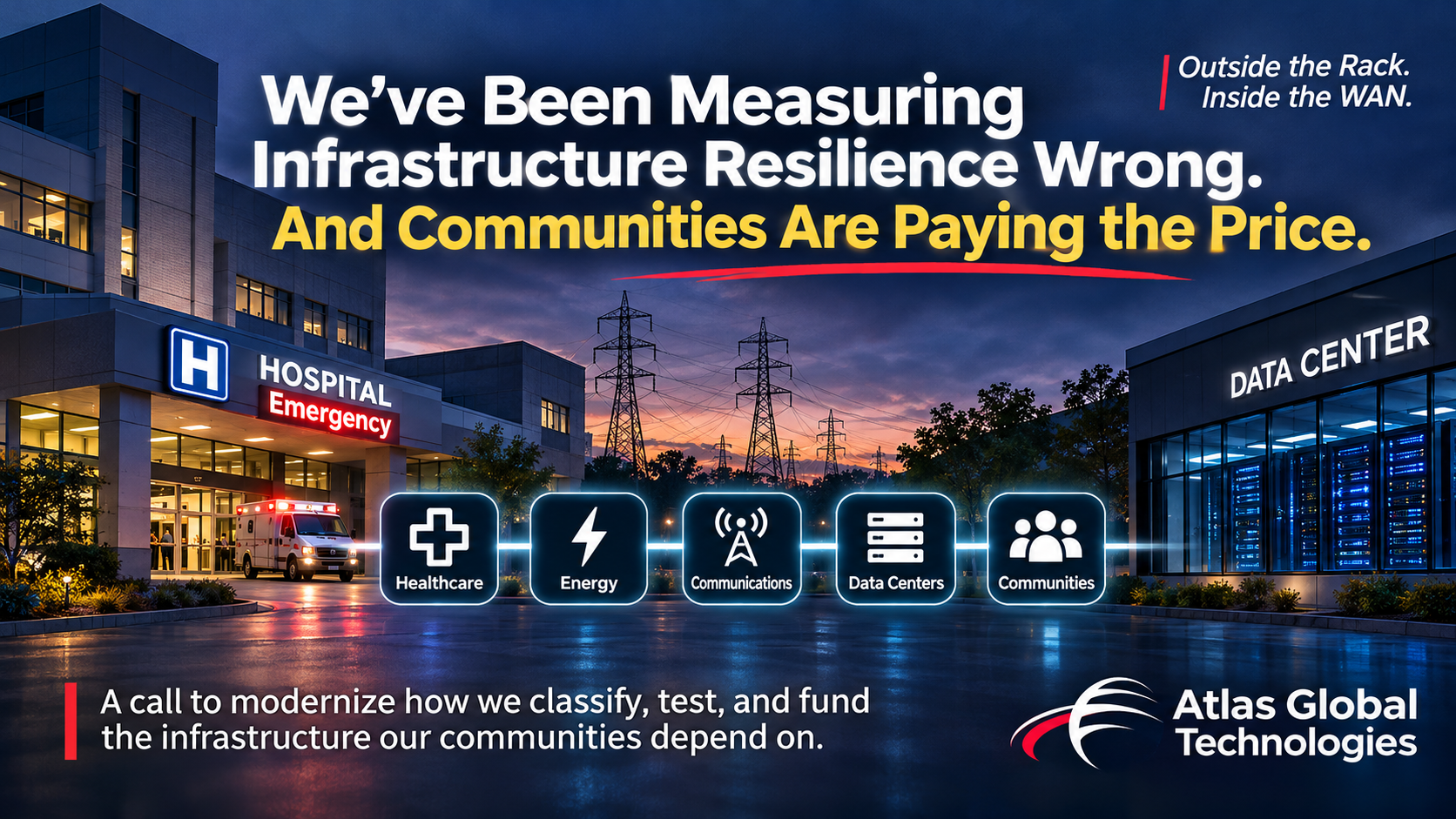
There's a question I've been coming back to throughout this week.
What does it actually mean for infrastructure to be resilient?
We've spent decades building bigger data centers, faster networks, more sophisticated electrical systems, and increasingly powerful technologies. We've developed standards, certifications, disaster recovery plans, and entire industries dedicated to keeping everything running.
And yet I think we're still asking the wrong question.
We keep asking how reliable a facility is.
I think we should be asking something much more important.
What happens to the people who depend on that facility when everything goes wrong?
Because those are two very different questions.
A Hospital Doesn't Have to Be Large to Be Essential
Consider what happened with Commonwealth Health here in northeastern Pennsylvania.
Wilkes-Barre General Hospital, Regional Hospital of Scranton, and Moses Taylor Hospital faced serious financial difficulties. Their future became a matter of regional concern because these facilities provide healthcare services that communities throughout Luzerne and Lackawanna counties depend on.
In February 2026, Tenor Health Foundation acquired the three hospitals after an extended period of uncertainty.
Wilkes-Barre General provides important inpatient and emergency services to the Wyoming Valley. Regional and Moses Taylor have played significant roles in acute-care and emergency healthcare in Lackawanna County.
Now consider the roles of Geisinger Wyoming Valley and Geisinger Community Medical Center in Scranton within the regional care network.
They perform different roles within a regional healthcare system that also depends on smaller hospitals, emergency departments, outpatient facilities, and emergency medical services.
A smaller facility doesn't become less important simply because it lacks the resources of a major trauma center.
The question is what happens when its services are no longer available.
Can surrounding hospitals absorb the patients? Can emergency medical services transport people farther without compromising care? Are there enough available beds, specialists, and supporting resources?
And what happens when multiple facilities are affected simultaneously?
The history at Wilkes-Barre General shows why it matters to track which services a region can actually deliver. The hospital was absent from Pennsylvania’s updated trauma roster in October 2021. A former trauma program coordinator alleged that management was weighing options for the program around that time. The court opinion recounts her allegation. In March 2022, the nurses’ union reported pay and staffing pressures. The hospital ended inpatient maternity and delivery services in July 2023. Those events establish a timeline. The available record leaves the cause of the trauma decision and any separate NICU closure date unresolved.
That's why I believe infrastructure resilience needs to begin with an independent Business Impact Analysis.
Before deciding what tier a hospital or data center should meet, we need to understand its mission, the services people depend on, and the consequences if those services disappear.
Size doesn't determine importance. Consequences do.
The Problem Isn't Always the Technology
I don't believe the infrastructure industry arrived at its present challenges simply because people were careless or unwilling to invest.
The world changed.
Cloud computing transformed how organizations consume technology. Artificial intelligence and high-performance computing are creating enormous new demands for electricity, cooling, networking, and computational capacity.
Healthcare has become increasingly dependent on interconnected digital systems. Emergency communications rely on infrastructure that may be owned and operated by multiple organizations.
And much of the infrastructure supporting these services was designed before anyone fully understood the scale of today's demands.
We cannot reasonably expect engineers twenty or thirty years ago to have predicted every technological development we're experiencing today.
But we can recognize that the systems we've inherited need to evolve.
And I think that evolution needs to be much more fundamental than adding another generator, another backup circuit, or another certification requirement.
We Need to Rethink the Data Center Tier System
The existing data center Tier I–IV classifications have provided an important framework for evaluating infrastructure redundancy and availability.
The Uptime Institute's classification system distinguishes facilities according to characteristics such as redundant capacity, maintainability, distribution paths, and fault tolerance. Its operational sustainability framework also recognizes the importance of management behavior.
Those are valuable foundations.
But I believe we need to go further.
We're dealing with cyberattacks, artificial intelligence, increasingly concentrated cloud infrastructure, energy constraints, interconnected supply chains, and organizations whose essential services extend far beyond the walls of their facilities.
I think it's time for the industry to consider a comprehensive modernization of how infrastructure resilience is classified.
Not simply adding a fifth tier to the existing system.
I'm talking about developing a unified Tier I–V framework that evaluates operational survivability, cybersecurity, energy independence, environmental efficiency, external dependencies, and the human factors involved in keeping critical infrastructure running.
And I think we need to be much more demanding about what certification actually means.
A facility shouldn't qualify for a higher tier because it excels in one area while failing in another.
Every applicable requirement should have to be met.
At Atlas Global Technologies, one of the principles guiding our proposed architecture is No Shared Fate.
That doesn't mean organizations shouldn't cooperate. Quite the opposite.
It means cooperation should not require everyone to become vulnerable to the same failure.
What Would a New Framework Look Like?
Here's one possible starting point for discussion.
| Proposed tier | Operational autonomy | Minimum operating capacity |
|---|---|---|
| Tier I | 7 days | 50% |
| Tier II | 14 days | 55% |
| Tier III | 21 days | 60% |
| Tier IV | 25 days | 65% |
| Tier V | 30 days | 75% |
These are proposed targets, not an existing industry standard or a finalized Atlas certification.
An independent third party would conduct a facility-level Business Impact Analysis (BIA) to identify the operations and solutions essential to the facility’s mission and service delivery, and the minimum capacity needed to sustain them. The regional resilience plan would determine each facility’s tier. Data center operators, critical infrastructure providers, government agencies, hospitals, and other regional stakeholders would develop that plan together, taking into account shared dependencies and the consequences if a facility’s services become unavailable. The proposed tiers set minimum operating capacity thresholds of 50% to 75% of the facility’s defined normal capacity. Each mission-critical function must also meet the minimum service level identified by the BIA.
A hospital might postpone elective procedures during an extended emergency. The assessment would identify which clinical functions must continue and at what service levels. Every function designated mission-critical must meet its assessed minimum throughout the autonomy period. A facility couldn’t make up for a failure in emergency care by keeping more elective capacity available.
And when I say seven or thirty days of autonomy, I don't mean having enough diesel fuel to run a generator.
I mean the ability to sustain the required mission, including power, cooling, water, communications, security, staffing, and other essential dependencies, without assuming outside support will arrive on schedule.
A contract with a supplier isn't proof that the supplier can reach you during a regional disaster.
A service-level agreement doesn't guarantee that a telecommunications carrier will survive the same event affecting your facility.
And a force majeure clause isn't going to restore electricity to an intensive care unit.
You cannot contract your way out of a physical dependency.
Modernization Cannot Happen in Isolation
We could spend hundreds of millions of dollars improving hospitals throughout northeastern Pennsylvania.
We could expand trauma capacity, upgrade emergency departments, modernize clinical systems, and improve internal redundancy.
But what happens if the regional electrical infrastructure remains vulnerable?
Or the telecommunications infrastructure?
Or the transportation routes needed to move patients, supplies, and emergency personnel?
We haven't solved the larger problem.
We've improved individual facilities while leaving the region exposed to common failures.
That's why I believe hospitals, utilities, telecommunications operators, data centers, emergency management agencies, governments, and other stakeholders need to come together to develop coordinated regional modernization plans.
That includes the generation and transmission systems coordinated by organizations such as PJM Interconnection, as well as the local distribution infrastructure that actually delivers electricity to facilities.
Each organization must retain responsibility for its own operations.
But they need to understand where their dependencies intersect.
And we need neutral third parties to identify those vulnerabilities rather than allowing every organization to declare its own infrastructure sufficiently resilient.
We Have to Figure Out How to Pay for It
I can already hear the objection.
This sounds expensive.
It is.
But I think we're making a mistake when we treat the cost of modernization as though it exists in isolation from the cost of infrastructure failure.
There's also a real economic danger in imposing dramatically higher standards without helping operators achieve them.
If smaller data centers, community hospitals, and regional service providers cannot afford to modernize, some may close or consolidate.
We could end up with fewer providers, greater concentration, and more organizations depending on the same infrastructure.
That would undermine the resilience we're trying to create.
I believe we should examine a financing approach similar in principle to the federal Meaningful Use initiative that helped accelerate electronic health record adoption.
Under the HITECH Act, eligible healthcare providers could receive Medicare and Medicaid incentive payments for adopting and meaningfully using certified electronic health record technology.
The important lesson isn't that government should simply purchase new equipment for private organizations.
It's that financial assistance can be tied to defined performance requirements.
For infrastructure modernization, I would explore combining operator investment, private financing, nonprofit participation, and federal and state assistance.
Then tie that assistance to independently verified improvements in resilience.
Existing facilities could receive modernization schedules based on their required classification:
- Tiers I and II: Up to six years.
- Tier III: Up to seven and a half years.
- Tiers IV and V: Up to ten years.
The intended tier would be established from the beginning, with milestones throughout implementation. These wouldn't be consecutive waiting periods.
And financial assistance should consider both the public importance of the facility and its ability to finance the necessary improvements.
A financially constrained community hospital shouldn't be expected to fund the same proportion of a modernization project as a well-capitalized organization simply because both need to achieve the same resilience classification.
The technical requirements should remain consistent.
The financing arrangements don't have to be identical.
Think Beyond a Single Funding Source
Here's another mistake I think we make.
Suppose emergency management agencies have $150 million available for regional resilience projects.
That doesn't necessarily mean we're limited to $150 million in improvements.
Maybe an electrical modernization project also creates opportunities for energy storage, distributed generation, renewable energy, or more efficient infrastructure.
Some components might qualify for other energy or infrastructure programs. Others might attract private investment or utility financing.
We should conduct a cost-benefit analysis, determine where the investment will produce the greatest benefit, and then explore every legitimate financing mechanism available.
Of course, funding eligibility matters. We cannot assume every project qualifies for every program or use multiple grants improperly for the same expense.
But we shouldn't abandon an important project simply because one funding source cannot cover its entire cost.
And when public funding helps finance emergency preparedness, there should be an enforceable public benefit in return.
If taxpayers help fund infrastructure intended to protect hospitals and emergency communications, those promised capabilities should be independently verified and maintained.
A Disaster Recovery Plan Isn't a Crystal Ball
There's an old observation among continuity professionals that a disaster recovery plan rarely survives its first real disaster unchanged.
Not necessarily because the plan was poorly written.
Because there is an enormous difference between an exercise and the real thing.
During a drill, we know which systems we're testing. We know who's participating. We usually know when the exercise begins and ends.
A real disaster doesn't cooperate.
The generator might work, but the fuel delivery route is flooded.
The network might fail over, but an authentication service is unavailable.
The backup systems might function perfectly, but the employees needed to operate them cannot reach the building.
That's why we need both planning and the ability to adapt when reality refuses to follow the plan.
For hospitals and other life-critical facilities, exercises must be carefully controlled to protect patients and personnel.
That means combining safe live failover testing, independently validated simulations, resource verification, and realistic disaster scenarios.
It also means repeating those exercises, because the infrastructure you certified two years ago may not be the infrastructure you're operating today.
Annual or biennial recertification, depending on the facility and its responsibilities, would be a reasonable starting point.
The Most Dangerous Failure May Be Human
There's another observation I've heard repeatedly in continuity discussions.
The longer an organization goes without a serious disaster, the easier it becomes to believe that its preparedness is sufficient.
That isn't a statistical law.
It's a warning about complacency.
Facilities expand. Equipment changes. People retire. Procedures become outdated. New dependencies appear.
And if nothing goes wrong, organizations can begin confusing the absence of disaster with proof of resilience.
Human behavior has to be part of any credible certification framework.
Are employees properly trained?
Can engineers report concerns without retaliation?
Does management investigate near misses?
Are staffing and fatigue managed appropriately?
Does leadership listen when someone identifies an uncomfortable vulnerability?
Or does the organization simply assume that twenty years without a major outage means everything must be fine?
I've always believed complacency and ego can be more dangerous than the equipment itself.
A sophisticated infrastructure design means very little if the people responsible for operating it are unwilling to acknowledge its weaknesses.
Independent assessors should be able to require corrective action, place certification under review, and, when a serious risk warrants it, suspend certification.
But enforcement should be proportionate. The objective is to correct dangerous conditions, not unnecessarily close facilities that communities depend on.
Resilience Is Bigger Than Any One Company
I want to be clear about something.
This isn't an argument that every facility needs to be built to the same specifications.
A small community hospital and a major regional trauma center don't have identical missions.
A commercial colocation facility and an emergency communications center don't have identical responsibilities.
But they all exist within a larger system of dependencies.
And their resilience requirements should reflect the consequences of their failure.
That means developing standards collaboratively, assessing facilities independently, modernizing infrastructure responsibly, and finding ways to finance those improvements without destabilizing the economy.
It means recognizing that the electricity industry, telecommunications providers, healthcare systems, data centers, emergency management organizations, and governments all have roles to play.
And it means accepting that certification is not a trophy to hang on a wall.
It's a continuing obligation to the people who depend on you.
The Question We Should Be Asking
Imagine an executive telling me that their facility has operated for twenty years without a major disaster.
They have excellent uptime.
They've passed their audits.
They have redundant infrastructure.
And they want to know why they should spend millions of dollars preparing for something that might never happen.
My answer is simple.
Because you, your stakeholders, and the community at large can't afford for you not to. Plain and simple.
Sources and further reading
Court opinion recounting the former trauma coordinator’s allegations
Pennsylvania Trauma Systems Foundation: Accredited trauma centers
Geisinger: Wyoming Valley Medical Center and its regional trauma capabilities
Community Health Systems: SEC filing confirming the February 2026 hospital sale
WVIA: Commonwealth Health acquisition, financial support, and regional hospital operations
CMS: HITECH Act and Meaningful Use incentive-payment oversight
Editor's note: The proposed Tier I–V requirements are presented for industry discussion and have not been adopted as an official certification standard.